Ensuring compliance in small business HR amidst evolving regulations
Updated: Jul 11
For small businesses, HR compliance is no longer a once-a-year checklist, it’s an ongoing operating system. Regulations are evolving quickly, courts are reshaping agency rules, and state and city pay transparency laws are changing how you recruit, promote, and document decisions.
The good news is that you don’t need a large HR department to stay compliant. You need a practical framework: track what changed, translate it into a few repeatable workflows, and keep audit-ready records. This article highlights recent regulatory developments and turns them into manageable actions for small teams.

1) Build a “living compliance calendar” instead of chasing lines
Small business HR teams get hit hardest by “compliance whiplash”, when rules are announced, delayed, litigated, or reversed. A living compliance calendar is a simple tool that lists: what applies to you, what deadline is real, what is on hold, and what is pending court outcomes.
Start by separating three categories: (1) effective rules you must follow now, (2) rules with future effective dates you can prepare for, and (3) rules “on hold” due to litigation. For example, the NLRB states the 2023 joint-employer rule’s effective date is “on hold pending litigation,” which belongs in category (3), with notes on your current risk posture if you use staffing agencies, franchise relationships, or vendors.
Assign an owner and a review cadence. Even a quarterly 30-minute review (plus a quick check when a major court decision drops) will outperform reactive scrambling. Your calendar should link to internal policy owners (HR, payroll, hiring managers) and store proof of the last update.
2) Immigration verification: treat Form I-9 as a system, not a form
USCIS issued Form I-9 updates in April 2025 using edition date 01/20/25, described as “minor changes” that align statutory language (including checkbox wording). Separately, E-Verify case-creation citizenship status selections were updated starting April 3, 2025, so the operational impact can show up inside your E-Verify workflow, not just on the PDF.
If you use an electronic I-9 platform, USCIS guidance also created a clear implementation deadline: employers must update electronic I-9 systems to reflect the 05/31/2027 expiration date no later than July 31, 2026. For small businesses, the key is to calendar this and get a written confirmation from your vendor (or internal IT) that the system is updated on time.
Finally, don’t over-rely on initial E-Verify results as a “set it and forget it” clearance. An AP-reported case highlighted that E-Verify may confirm a worker at hire but does not automatically alert employers if work authorization later changes. The practical takeaway is to maintain lawful reverification and document tracking where required, without discriminating or creating unnecessary rechecks.
3) Overtime compliance “whiplash”: stabilize your classification approach
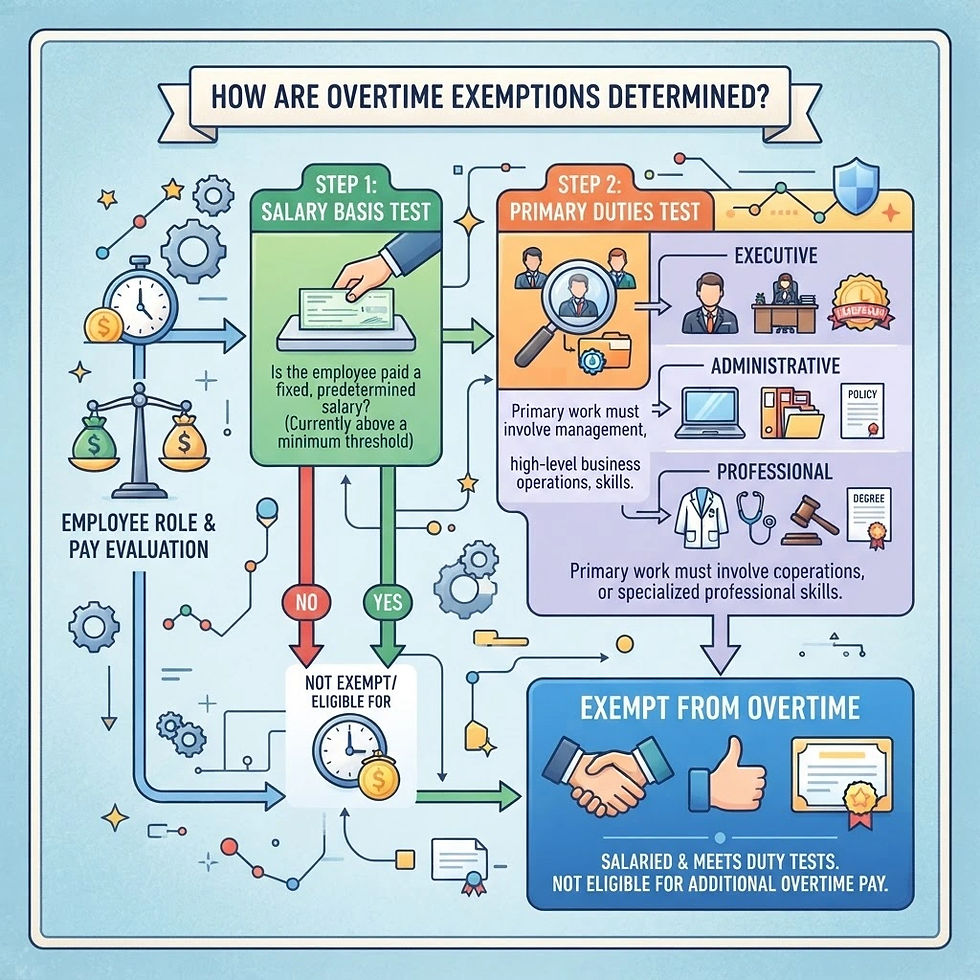
The Department of Labor published a Small Entity Compliance Guide for the 2024 final overtime rule, including a threshold schedule such as $844/week on July 1, 2024 and $1,128/week on January 1, 2025, plus a future updating mechanism. Many small employers used these figures to plan raises, reclassifications, or budgeting.
But multiple employer-law analyses report that the Eastern District of Texas vacated DOL’s 2024 overtime rule on Nov. 15, 2024, reverting to the 2019 salary thresholds and undoing the increases (including those that had already taken effect in July 2024). This is a classic compliance whiplash scenario: payroll may have changed, offers may have referenced higher thresholds, and managers may have shifted duties based on an expected new rule.
A resilient approach focuses on the fundamentals you control: (1) confirm exempt/nonexempt classifications using duties tests and actual job content, (2) ensure timekeeping practices are accurate and consistently enforced, and (3) document why you made each classification decision. When salary thresholds shift, your core documentation should still support compliance.
4) PWFA: implement accommodations now, manage the litigation patchwork carefully
The EEOC’s final rule under the Pregnant Workers Fairness Act (PWFA) was issued April 15, 2024 (published in the Federal Register April 19, 2024) and became effective June 18, 2024. PWFA requires reasonable accommodations for known pregnancy-related limitations, bringing a clearer, structured accommodation framework to employers covered by the law.
For small HR teams, the operational move is to standardize the accommodation intake process: a simple form, an interactive discussion checklist, and manager training on recognizing requests (including informal ones). Keep documentation focused on the limitation, the requested accommodation, alternatives considered, and the final decision, without drifting into unnecessary medical detail.
At the same time, compliance uncertainty exists because courts have vacated or blocked enforcement of certain abortion- and fertility-related accommodation provisions in EEOC’s PWFA regulations for some employers, while leaving other parts intact. AP coverage underscores that this creates a patchwork risk-management issue: your safest course is to follow PWFA’s core accommodation obligations and consult counsel on jurisdiction-specific impacts, while maintaining a consistent, non-retaliatory process.
5) Pay transparency: helping small business HR convert posting requirements into a repeatable workflow
Pay transparency is expanding rapidly across states and cities, and it impacts recruiting operations as much as compensation philosophy. A Mercer survey of 1,600+ multinationals across 60 markets (reported Feb. 16, 2026) found about 50% “prepared” in 2025 versus 32% in 2024, yet only 14% fully implemented. Small businesses can compete by being systematic even if they’re not sophisticated.
In Illinois, pay transparency in job postings takes effect Jan. 1, 2025. Illinois Department of Labor guidance says employers with 15+ employees making covered postings must include the pay scale and benefits, and must notify current employees of promotional opportunities. The same guidance notes an IDOL policy effective Jan. 1, 2026 allowing anonymous complaints to be treated as reports IDOL may investigate, raising the importance of consistent posting templates and retention of posting records.
In Massachusetts, the Wage Transparency Act was signed July 31, 2024. Mass.gov explains that wage ranges must be included in job postings starting Oct. 29, 2025 for employers with 25+ employees, and it also adds workforce demographic/EEO reporting obligations (for covered filers, such as EEO-1 submission by Feb. 1 annually starting 2025). Massachusetts guidance puts the core obligation plainly: “any employer with 25 or more employees… must disclose the pay range in the job posting.”
6) Enforcement reality: “scraped postings” and cure windows change the risk equation
Compliance isn’t just about what you publish, it’s also about how your postings appear across platforms. A New York City Council investigation analyzed more than 60,000 unique job postings (from sources like Indeed and Google for Jobs) and found job seekers could still encounter thousands without salary ranges due to scraping mechanics. That means an employer can be compliant on its own site but still show up as noncompliant elsewhere.
Small businesses should take two practical steps: (1) maintain a single “source of truth” posting that always contains required pay range language, and (2) periodically audit how your jobs render on major aggregators. Keep screenshots and timestamps. If a platform truncates or fails to display the range, you’ll want evidence you posted compliant content and made reasonable efforts to correct downstream display.
Massachusetts also offers an enforcement mechanic that small HR teams can use to build safer processes: escalating penalties plus a “notice to cure” window for wage-range posting defects (available through Oct. 29, 2027). Mass.gov summarizes a first-offense warning and then increasing fines, which makes early self-audits and quick remediation a cost-effective strategy.
7) Policies in flux: joint employer and noncompetes require “status-aware” documentation
Not every line creates a new rule you must implement today. The NLRB states the 2023 joint-employer rule effective date is on hold pending litigation. If your business relies on staffing firms or franchise/vendor models, don’t rewrite contracts every month, but do clarify operational controls: who sets schedules, who supervises, who disciplines, and who controls pay practices.
Similarly, the FTC states its Noncompete Rule “is not in effect and it is not enforceable,” referencing an injunction order dated Aug. 20, 2024, and it notes FTC steps to dismiss its appeal on Sept. 5, 2025. For small employers, that means you should not assume a nationwide noncompete ban is currently active based on the FTC rule alone.
The compliance play is “status-aware” documentation: maintain a brief internal memo that lists the current status (effective, stayed, enjoined, vacated, on hold), what you are doing today, and what trigger would cause a change. This prevents managers from acting on outdated assumptions and helps show good-faith compliance if audited.
Ensuring compliance in small business HR is less about perfect prediction and more about building durable routines. When agencies update forms like the I-9, courts vacate overtime rules, and pay transparency laws expand, the businesses that win are the ones with calendars, templates, audits, and clear ownership.
Focus on a few high-impact systems: hiring and verification, wage-and-hour classification and timekeeping, accommodations, and job posting workflows. Add a “what changed” review quarterly, and keep evidence of your good-faith efforts. That combination, process plus documentation, will carry you through evolving regulations with far less disruption.