
HR Compliance Audit: Step‑by‑Step Checklist & Templates
Updated: Oct 12
HR compliance audit: Run a complete HR compliance audit in 4–12 weeks for a typical mid‑size company, with meaningful quick wins in the first 7 days.
This guide walks you through a practical, seven‑step hr compliance audit framework, realistic timelines by company size, a master HR compliance checklist, a prioritized remediation playbook, and the exact templates HR Business Partners uses when we run audits for small and midsize companies. Read to the end and you’ll be able to plan and execute a full audit, score your risk, and produce a 30/60/90 remediation plan that reduces legal and financial exposure.
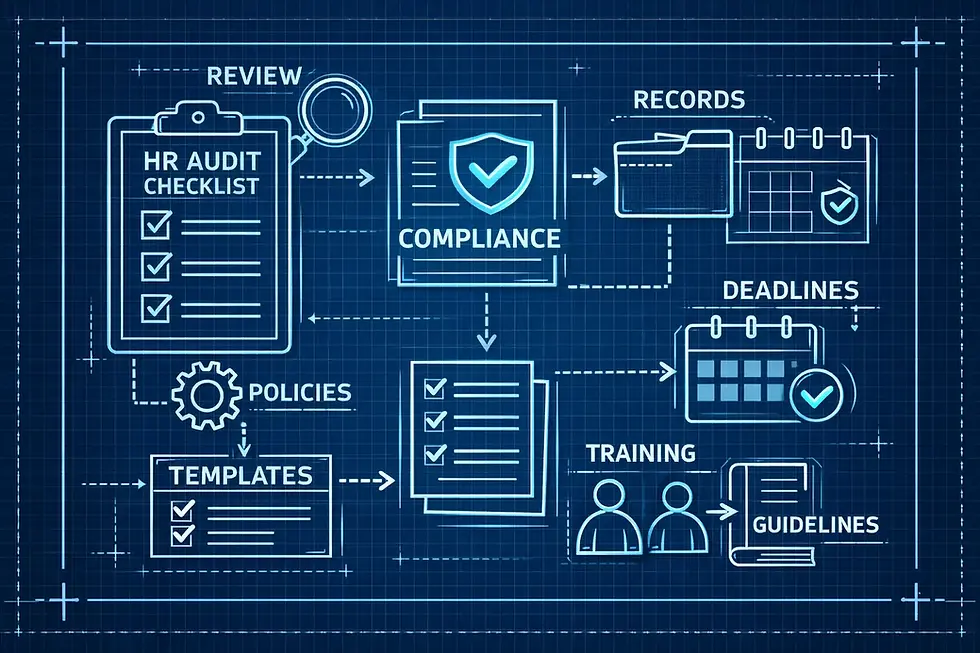
What to do first (60–90 seconds) One‑line promise: Run a full HR compliance audit in 4–12 weeks (mid‑size) using the checklist and templates in this guide. Quick wins possible in 7 days.
What this guide gives you: a 7‑step hr compliance audit framework, recommended timeboxes, a full HR compliance checklist, a remediation plan template, and downloadable spreadsheets used by HR Business Partners. 3 immediate actions (the 15‑minute quickstart)
Export headcount and payroll from your HRIS/payroll provider (CSV with names, hire dates, job codes, hours, wages).
Confirm who will own the audit: an HR lead plus a leadership sponsor (legal or operations if available).
Review the checklist in this guide and schedule the kickoff memo with managers.
Why run an HR compliance audit now (and how HR Business Partners helps)
There are three reasons to run a hr compliance audit now: regulators are active, fines and back pay add up fast, and small errors cascade into turnover and legal risk. The aggregate cost of compliance failures can reach millions to organizations when fines, back pay, and legal fees are included.
Typical triggers we see in the field: misclassification under the FLSA, incomplete I‑9s, inconsistent leave administration, and gaps in personnel files. These issues not only invite regulatory action but also undermine employee trust—retaliation claims alone account for a large share of EEOC complaints.
How HR Business Partners approaches audits: we provide fractional HR and compliance audits under a predictable model. That means a defined scope, fixed timelines, and the same checklist and templates included in this guide. For small and midsize firms we combine a practical audit with hands‑on remediation support (one‑off audits, 90‑day remediation sprints, or ongoing fractional HR under a flat monthly fee).
Who this guide is for: small and midsize companies, startups prepping to scale, and multi‑state employers. If you’re an enterprise legal team with existing compliance programs and formal AAP/Audit units, you may only need specific sections (I‑9s, payroll testing).
What an hr compliance audit actually is (quick definitions)
Language matters. Here’s a quick glossary so you pick the right scope:
HR compliance audit: A targeted legal and records review focused on statutory obligations (I‑9, FLSA, FMLA, OSHA, ERISA, etc.) and required documentation.
HR audit: Broader — includes operations, HR effectiveness, performance systems, and culture items beyond regulatory compliance.
HR compliance review: A lightweight check focused on specific areas (payroll, I‑9s, personnel files) rather than a full audit.
Types of audits you might pick:
Targeted (payroll, I‑9s)
Operational (processes and controls)
Full compliance (policies, files, systems)
Personnel file audit (complete file contents)
Expected outcomes: a prioritized gap list, evidence mapped to findings, a remediation plan with owners and deadlines, and a documented follow‑up schedule.
Common HR audit areas include wage and hour classification, I-9 documentation, personnel files, leave administration, employee handbooks and policies, safety records, contractor classification, and investigation or complaint records. 7‑step HR compliance audit framework (step‑by‑step with timeline)
This is the heart of the guide. Use the timeboxes below as a planning baseline—adjust for complexity or multiple locations.
Recommended timeboxes by org size:
Small (≤50 employees): 2–4 weeks
Medium (50–250 employees): 4–8 weeks
Large (250–1,000 employees): 8–12 weeks
Phases (visual suggestion: a 7‑phase Gantt with overlapping data collection and review phases works best).
Step 1 — Determine scope & objectives (1–2 weeks)
Decide whether you’ll run a full audit or a sample audit (sampling speeds up delivery). Prioritize domains—wage & hour, I‑9s, benefits, leaves, terminations—based on risk and recent events.
Who to invite: HR lead (owner), leadership sponsor, payroll, IT (for exports), operations, and legal when required. Consider an external consultant for objectivity.
Deliverables: scope memo (one page), success criteria (what “closed” looks like), stakeholder map.
Step 2 — Identify applicable laws & prepare communication (3–5 days)
Compile federal, state, and local laws that apply to your employee locations. Draft a kickoff memo for staff and managers that explains goals, timelines, document requests, confidentiality rules, and a non‑punitive tone.
Deliverables: law list by jurisdiction and a kickoff memo template (use the included template to reduce fear and encourage cooperation).
Step 3 — Gather documents & inventory systems (1–2 weeks)
Inventory your systems: HRIS, payroll vendor, ATS, timekeeping, benefits platform, background check vendors, LMS. Create a centralized folder and begin collecting core documents: I‑9s, W‑4s, offer letters, employment agreements, personnel files, payroll ledgers, timesheets, handbooks, benefit notices, training logs, and OSHA records. For federal documentation and retention guidance, refer to Worker.gov's documentation guidance.
Step 4 — Review policies, records & conduct interviews (1–3 weeks)
Use a sampling approach for personnel files and payroll tests (e.g., 10–20% random sample plus high‑risk groups such as recent terminations or overtime disputes). Review policies for consistency with law (handbook, classification language, leave policies, ADA/EEO statements).
Conduct structured interviews: HR, payroll, a sample of managers, and a small group of employees. Capture discrepancies between written policy and practice.
Step 5 — Analyze findings & score risk (1 week)
Use a risk scoring rubric that weights legal exposure, financial impact, recurrence likelihood, and operational disruption. Categorize findings: Critical, High, Medium, Low. Produce an annotated findings spreadsheet and a risk heatmap. For practical scoring methodologies and remediation examples, see AuditBoard's HR audit best practices.
Step 6 — Build recommendations & corrective action plan (1–2 weeks)
For each finding include: specific action, owner, due date, required resources, and proof of completion. Separate quick wins (policy clarifications, missing acknowledgements, system configuration) from long‑term fixes (reclassification projects, bulk payroll corrections).
Deliverable: remediation workbook with 30/60/90 milestones.
Step 7 — Implement, monitor & schedule follow‑up (ongoing)
Design a dashboard to show completion percentage, overdue items, and risk trending. Set a re‑audit cadence: annual full audit with targeted checks after hiring spikes, M&A, or multi‑state expansion. Transfer knowledge through updated handbooks and manager training.
Phase | Small org | Medium org | Large org |
Scope & Communications | Week 1 | Week 1–2 | Week 1–2 |
Data Collection | Week 1–2 | Week 2–4 | Week 2–5 |
Review & Interviews | Week 2–3 | Week 4–6 | Week 5–8 |
Analysis & Remediation Plan | Week 3–4 | Week 6–7 | Week 8–10 |
Implement & Monitor | Ongoing | Ongoing | Ongoing |
HR compliance audit checklist — documents & systems to review
Use this master checklist as your working inventory. Decide early whether you’ll do a sample review or a full review; mark required evidence and retention notes for each item.
Hiring & onboarding
Job descriptions and classification (exempt vs. non‑exempt)
Offer letters and employment agreements
W‑4s and tax documentation
I‑9 forms: completion, acceptable documents, and retention
Background check consents and FCRA adverse action notices
Onboarding checklists and policy acknowledgements
For a clear step‑by‑step walkthrough on performing an HR compliance audit, this how to perform an HR compliance audit guide is a useful companion to the templates and checklist above.
Personnel files & employee records
Core personnel file contents: hiring docs, performance reviews, disciplinary records
Separate confidential/medical files (FMLA/ADA medical info)
Separation documents: resignation letters, termination notices, final pay records
Training records and certifications
Timekeeping & payroll
Timesheets/time clock data, payroll register/export
Exempt/non‑exempt classification review
Overtime calculations and pay corrections
Tax withholdings and tip reporting
Benefits & leave
ERISA plan documents, SPDs, and summary notices
COBRA election notices and timelines
FMLA eligibility and designation records
State paid leave compliance (where applicable)
Policies & handbooks
Employee handbook and policy revision dates
Anti‑discrimination and harassment policies
ADA accommodation procedures and interactive process logs
Remote work, PTO, and termination policies
Whistleblower and anti‑retaliation language
Safety & workplace
OSHA 300/301 records and incident reports
Safety training logs and hazard assessments
Terminations & layoffs
Final pay timelines and state compliance
WARN notices (if applicable)
Severance agreements and release forms
Contractors & classification
Independent contractor agreements and tests (1099 vs. W‑2)
Vendor/contractor insurance and indemnity clauses
Systems & reporting
HRIS data exports and audit logs
Access controls, permissions, and data privacy measures
Backups and retention schedules
Investigations & complaints
HR complaint logs, investigation notes, outcomes and timelines
Discipline logs and corrective action history
Appendices included in the templates: I‑9 checklist, personnel file audit sample form, payroll test sample template.
Federal & common state laws to include (audit checkpoints)
Below is a compact set of checkpoints. For state law specifics, add a jurisdiction column in your tracker and map thresholds (employee count triggers, paid leave rules, final pay timelines).
Law | What to check | Typical thresholds |
FLSA (Wage & Hour) | Payroll records, exempt status, overtime calculations, hours worked | Applies to most employers federally; state minima may be higher |
FMLA | Leave designations, eligibility, medical certifications, recordkeeping | 50+ employees within 75 miles (federal) |
ADA / ADAAA | Accommodation requests, interactive process documentation | No employee count threshold federally |
Title VII / EEOC | Discrimination policies, training records, complaint handling | 15+ employees (ADEA also 20+ in most cases) |
ERISA / COBRA | Plan documents, SPDs, COBRA notices | 20+ employees for COBRA |
FCRA | Background check consents and adverse action notices | Pre‑employment checks require consent |
I‑9 / IRCA | I‑9 completion, acceptable documents, retention rules | Form I‑9 for all hires; retain 3 years after hire or 1 year after termination (whichever later) |
OSHA | Injury logs, training, hazard assessments | Varies; some local OSHA rules may apply |
Most common HR audit findings & the consequences
Wage & hour issues
Common findings: misclassification (exempt vs. non‑exempt), missed overtime, and incorrect pay calculations. Consequences include back wages, liquidated damages (potentially double back pay), civil penalties, and legal fees.
Missing or incorrect I‑9s
Finding incomplete or missing I‑9 forms is frequent. Penalties can range from technical fines to much larger penalties for knowing violations—plus the operational headache of responding to ICE audits.
Incomplete personnel files and poor recordkeeping
Missing hiring docs, incomplete disciplinary records, and untracked FMLA requests weaken defenses in litigation and increase exposure to fines. Good recordkeeping is your primary defense.
FMLA and leave administration errors
Common issues are late designations, inconsistent leave treatment, and poor tracking. These raise retaliation and interference claims and possible reinstatement remedies.
Safety and OSHA non‑compliance
Failure to maintain logs, training records, or hazard responses can create fines and increase inspection risk.
Discrimination & retaliation complaints
Lack of documented investigations and inconsistent disciplinary records elevate settlement risk and operational disruption.
Real‑world pattern: Most large exposures are cumulative—the payroll correction for many employees, combined with weak documentation, multiplies the financial hit. Fixing root cause (timekeeping controls, classification policy, manager training) prevents repeated findings.
Prioritizing remediation: build a corrective action plan that works
Use a triage framework to move fast on high‑risk items while scheduling medium/low items into sustained improvements.
Use the audit findings to prioritize corrective actions by risk. Separate immediate compliance concerns from medium-term process improvements and longer-term policy or system work.
Triage framework
Critical: Immediate legal exposure (FLSA misclassification, missing I‑9s for many employees). Target 0–30 days.
High: Significant but not immediate (COBRA notices missing for a few employees). Target 31–60 days.
Medium: Process gaps and documentation that could escalate. Target 61–90 days.
Low: Optimization opportunities and non‑urgent training. Schedule for next review cycle.
Template fields for each finding
Finding summary
Root cause
Legal citations / reference
Recommended action
Owner
Due date and SLA tier
Proof required
Status & closure notes
Sample 30/60/90 remediation plan (200‑employee company)
Priority | Action | Owner | Due |
30 days (Critical) | Correct 12 missing I‑9s and document corrective steps | HR Lead | Day 30 |
60 days (High) | Reclassify 8 misclassified non‑exempt roles and retro‑pay overtime as needed | Compensation Manager | Day 60 |
90 days (Medium) | Update handbook, roll out manager training on leave and accommodations | People Ops | Day 90 |
Monitoring cadence: weekly remediation standups for 30/60 items, monthly compliance board updates for executives, and executive sign‑off on critical closures.
Evidence, documentation & preparing for enforcement audits
Regulators typically ask for I‑9s, payroll registers, policies with revision dates, and investigative files. Package evidence chronologically and include redacted copies where medical or confidential material is involved. For more on the types of evidence and recommended workflows to prepare for enforcement, see Paycor's HR audit guide.
Retention highlights
I‑9: 3 years after hire or 1 year after termination (whichever later)
Payroll records (FLSA): 3 years for basic payroll records; 2 years for wage rate tables
OSHA logs: 5 years for injury and illness records
Benefit plan documents (ERISA): 6 years for summary plan descriptions
Storing evidence securely
Limit access to HR files, maintain audit logs of downloads, and redaction templates for sensitive medical data. Keep separate medical/ADA files and restrict them to necessary personnel.
When to pull counsel
Bring legal counsel in when findings show systemic legal exposure (wage theft patterns, discrimination investigations) or when you expect agency enforcement. Handle low‑level documentation fixes internally with HR and payroll.
T ools, templates & step‑by‑step workflows
Included templates (what they are and how to use them):
One‑page quick checklist: Printable guide for the audit kickoff and manager distribution.
Full audit spreadsheet tracker: Filterable with status fields, owner, risk, and proof links.
Remediation plan template: Owner & SLA fields, 30/60/90 milestone tabs.
Personnel file audit form & I‑9 tracker: A record‑by‑record checklist for audits.
Manager interview guide & employee questionnaire: Structured questions to surface practice gaps.
Sample kickoff memo & employee communications: Language templates that reduce worry and encourage cooperation.
How to use the templates in practice (sample workflow)
Day 0–2: Export HRIS and payroll data and import into the audit tracker.
Day 3–10: Populate the tracker with documents and start I‑9 and payroll sampling.
Week 2–4: Conduct interviews and record findings directly in the tracker.
Week 4–6: Score risks, export remediation workbook, assign owners and SLAs.
Automation tips
Use HRIS exports and pivot tables to surface overtime patterns and high‑overtime employees.
Match payroll register employee IDs to I‑9 file names programmatically to find missing documents.
Use conditional formatting in the tracker to highlight overdue remediation items and critical risk types.
For an additional checklist and practical templates to pair with these workflows, consider reviewing industry templates and checklists such as those provided by HR technology and services firms.
How HR Business Partners can help
For teams that want help running this process, HR Business Partners supports three practical options (no surprise services):
One‑off compliance audit: Fixed‑fee delivery of findings and a remediation workbook using these templates.
Audit + 90‑day remediation sprint: Hands‑on execution with owners, weekly standups, and manager training.
Ongoing fractional HR: Monthly flat fee providing proactive policy monitoring, periodic compliance checks, and on‑demand compliance expertise.
Why this helps smaller companies: predictable cost, two decades of local Minneapolis experience, and corporate‑level templates and execution adapted to your budget and timeline. You get the same checklist and tracker shown here plus practical implementation support when you choose a remediation sprint or fractional HR.
What to expect: a clear timeline, a findings report with risk scoring, a remediation workbook with owners and SLAs, and confidential handling of all employee records. Sample pricing depends on scope; we offer fixed fees for one‑off audits and a flat monthly rate for fractional HR engagements.
Case study — what success looks like (60–90 seconds)
Situation: A 75‑person Minneapolis tech firm suspected classification errors after rapid hiring. We ran a targeted hr compliance audit focused on classification, payroll, and I‑9s.
Actions: 10‑day data collection, 2‑week review, and a 60‑day remediation sprint. Corrected classifications for 6 roles, updated offer letters, and implemented timekeeping controls.
Outcome: The company avoided an estimated six‑figure exposure by resolving misclassification and backpay risk, improved payroll accuracy, and rolled out manager training that reduced recurring issues.
Key lessons: prioritize payroll and I‑9 checks first, own the remediation timeline, and use the remediation workbook to keep leadership aligned.
FAQs & common concerns
How often should I do an hr compliance audit?
Annually is a good baseline; run targeted checks after major events (rapid hiring, multi‑state expansion, mergers, or when you get a complaint). Federal contractors and firms with high turnover may require more frequent reviews.
Do I need legal counsel for my audit?
Not for every audit. Use counsel when findings indicate systemic legal exposure (wage theft patterns, discrimination claims), for complex state law interpretation, or when responding to agency notices.
Can I run an HR audit if I have no HR team?
Yes. Use the templates and consider hiring a fractional HR provider (like HR Business Partners) or a consultant for objectivity and execution support.
What’s the difference between a personnel file audit and a full HR audit?
Personnel file audit focuses exclusively on file contents and retention. A full HR audit includes policies, payroll, benefits, processes, and systems.
How do I handle findings that involve senior leadership?
Escalate high‑risk findings to the board or outside counsel if necessary. Keep documentation strict and apply remediation SLAs consistently—perception of differential treatment is a common driver of retaliation claims.
Next steps & recommended 7‑day action plan
Start with a tight 7‑day plan to build momentum:
Day 1: Export HRIS & payroll data and confirm audit owner + sponsor.
Day 2: Download the one‑page checklist, I‑9 tracker, and remediation workbook templates.
Day 3: Send kickoff memo to managers and request centralized documents.
Day 4–5: Begin I‑9 and payroll sample checks for the most recent hires and highest‑paid non‑exempt employees.
Day 6: Conduct the first manager interview for a high‑risk team (e.g., operations/payroll heavy).
Day 7: Review early findings, categorize as Critical/High/Medium/Low, and assign initial owners.
Recommended 30/60/90 milestones: immediate fixes in 30 days, high‑risk remediation by 60 days, and policy/process updates by 90 days. Involve HR, payroll, legal (if needed), IT, and a leadership sponsor.
Download & consult: Import the tracker into your HRIS tools, run the first payroll pivots, and book a 30‑minute consult with HR Business Partners if you want external help scoping the work.
Appendix — quick templates & reference sheets
Sample scoring rubric (simple)
Score | Description | Action |
4 (Critical) | Legal exposure or material financial risk | Immediate action (0–30 days) |
3 (High) | Significant compliance gap | Short term (31–60 days) |
2 (Medium) | Process improvements needed | Medium term (61–90 days) |
1 (Low) | Optimization / documentation | Next review cycle |
Sample timeline table (reference)
Company size | Estimated audit length |
10 employees | 2–4 weeks |
50 employees | 4–6 weeks |
200 employees | 6–8 weeks |
500 employees | 8–10 weeks |
Document retention quick reference (select)
Document | Retention |
I‑9 | 3 years after hire or 1 year after termination (whichever later) |
Payroll records | 3 years (some items 2 years) |
OSHA logs | 5 years |
Benefit plan documents | 6 years |
Summary
Run your hr compliance audit with a clear scope, a centralized tracker, and a 30/60/90 remediation plan. Start with the HRIS export, pick an owner and sponsor, and use the one‑page checklist and I‑9 tracker to get traction in day one.
If you’d like help implementing this plan, HR Business Partners runs fixed‑fee compliance audits, audit + remediation sprints, or ongoing fractional HR under a flat monthly fee—using the exact templates in this guide. Download the templates or book a consultation to get started. For additional practical checklists and templates you can pair with these resources, see this concise industry checklist and walkthrough at how to perform an HR compliance audit.


