
Social Media Policy for Employees: Your No‑Nonsense Guide to Getting It Right
Updated: Oct 13
Let's be honest—your team is on social media right now, and what they share can directly impact your business. Ignoring this isn't a strategy; it's a risk you can't afford to take.
A social media policy for employees isn't about locking down personal accounts or being "Big Brother." It’s about creating a smart, clear framework that protects your brand, prevents legal nightmares, and empowers your employees to be positive ambassadors online.
Why Your Business Can't Afford to Ignore Social Media Anymore
The Problem: You're a busy founder or manager. The last thing you have time for is worrying about what your team is posting online. But imagine an employee venting about a "tough day at work" and the post goes viral. Or someone accidentally sharing an office photo that reveals confidential client info in the background.
These aren't just minor headaches; they can explode into brand damage, legal battles, and a PR crisis you have no time to manage. Without clear guidelines, your business is completely exposed.

The Real Risks Of Having No Policy
The potential for trouble is much bigger than you might think. Data shows that a staggering 89% of employees admit to using social media during work hours, and 50% of them post about their jobs online. The danger is that nearly 45% of companies still have no defined policy, leaving them wide open to all sorts of problems.
Without clear rules of the road, you open your business up to several very real risks. The table below breaks down just how quickly an undefined online presence can create tangible business problems.
The Hidden Costs of an Undefined Social Media Presence
Area of Risk | Potential Business Impact |
|---|---|
Reputation Damage | A single thoughtless post can tarnish your brand's image, erasing years of hard work. |
Legal & Compliance Breaches | Employees might inadvertently share sensitive information, leading to costly data breaches or violating industry regulations (like HIPAA or financial privacy laws). |
Decreased Productivity | Unchecked social media use during work hours can lead to a significant drop in focus and output across the team. |
Internal Conflict | Inappropriate comments about coworkers or the company can create a toxic work environment, hurt team morale, and increase turnover. |
These aren't just abstract threats; they are direct hits to your bottom line, culture, and long-term stability.
A Framework For Protection, Not Restriction
The Solution: This is where a social media policy for employees changes the game. It’s not about handing down a long list of restrictive rules.
Think of it as a crucial tool for protection and clarity. It’s a key part of proactive risk management in workplace ethics that sets everyone up for success.
A well-crafted policy provides the guardrails that protect both your employees and your company. It transforms ambiguity into clear expectations, empowering your team to use social media confidently and responsibly.
We know that drafting and implementing a legally sound policy can feel like one more overwhelming task on your already-full plate. That's exactly where we come in.
Our fractional HR services are built for busy businesses like yours. We handle the complexities of creating a policy that fits your culture, protects your assets, and gives you back the peace of mind to focus on growth.
Social Media Policy for Employees: The Core Components of an Effective Policy
So, you’re sold on why a social media policy is critical. Now, let’s dig into the what. A strong policy is your roadmap for managing online risks and protecting your brand, but it doesn't need to be an encyclopedia. Think of it as assembling a toolkit—each tool has a specific job, and together, they keep your business running smoothly.

First things first: you have to define the playground. A good policy clearly states what "social media" actually means for your business. This isn’t just about Facebook and X (formerly Twitter). It needs to cover everything from LinkedIn and Instagram to personal blogs, TikTok, review sites like Glassdoor, and even forums like Reddit.
Casting a wide net here prevents loopholes. It makes it clear to everyone that the guidelines apply across the entire digital world, not just a handful of popular sites.
Defining Your Company's Presence
Next, you need to draw a bright, clear line between official company posts and personal employee opinions. Your policy has to clarify who speaks for the company and when.
This section should answer a few key questions:
Who manages official accounts? Designate specific roles or individuals who are responsible for posting on your brand’s channels.
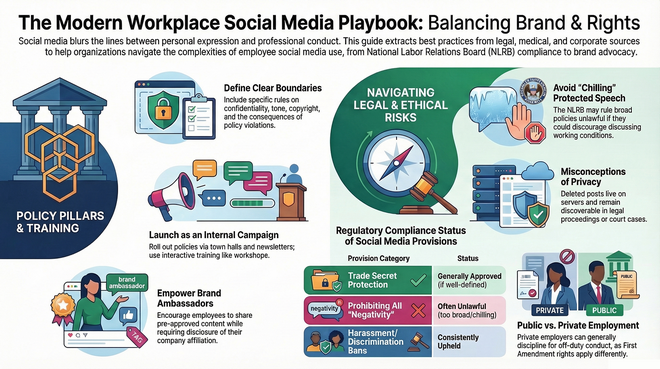
Are employees brand ambassadors? Decide if you want to empower your team to share company news. If so, provide them with pre-approved content or solid guidelines to follow.
What about personal accounts? Specify if employees should add a disclaimer in their bio (like, "Views are my own") when they mention working for your company.
Dell is a great example here. It requires employees who post about the company to disclose their relationship. It’s a simple rule, but it protects both the employee and the business from claims of deceptive marketing. That transparency builds trust.
Protecting Your Crown Jewels
Every business has information that should never, ever see the light of day on social media. This is your confidential information, and protecting it is non-negotiable. Your policy has to be crystal clear about what falls into this category.
A policy is only as good as its communication. Simply having rules on paper isn't enough when your team doesn't know they exist or what they mean.
There's a shocking gap between having a policy and employees actually knowing about it. While 80% of companies report having social media policies, a mere 51% of employees know those rules even exist. Worse, just 32% can recall any specific guidelines. You can find more social media at work statistics on Zippia to see the full picture.
To close this gap, your policy should explicitly forbid sharing:
Financial data: Sales numbers, revenue, budgets, and investor information.
Client and customer details: Names, project specifics, or any identifying information.
Internal strategies: Upcoming product launches, marketing plans, or operational details.
Employee information: Personal details about colleagues, salary information, or performance issues.
Creating these rules can feel overwhelming, especially when you’re busy running your business. This is where expert guidance becomes a lifesaver. Our fractional HR team specializes in crafting policies that are not just comprehensive but also perfectly aligned with your company’s unique culture and risks. We handle the details so you can stay focused on growth.
Ready to build a policy that actually works? Book a free consultation today, and let’s create a framework that protects your business and empowers your team.
Navigating Social Media Law and Employee Rights
Here’s where creating a social media policy gets messy. This isn’t just an internal memo you can whip up over a lunch break; it’s a document that has to walk a fine line between your business needs and some seriously complex labor laws.
Honestly, this is one of the biggest reasons business owners call us. They know a policy is necessary, but they’re terrified of overstepping and getting into legal trouble. It's a valid fear, and it’s where having an expert in your corner is a game-changer.
Think of it like navigating a legal minefield. One wrong step—a policy that’s too broad or restrictive—and you could find yourself in a world of hurt with federal agencies like the National Labor Relations Board (NLRB).
Understanding Protected Concerted Activity
The single most critical concept you need to grasp is protected concerted activity. It’s a legal term from the National Labor Relations Act (NLRA), but what it really means is pretty straightforward: your employees have the legal right to discuss their jobs with each other.
This includes talking about things like:
Wages and how much everyone is getting paid
Working conditions and safety on the job
Schedules and workload concerns
Problems with management or company rules
And here's the kicker: these protections absolutely extend to social media. So, if a couple of employees are venting about their low pay in a private Facebook group, that conversation is likely protected by law. A policy that just flatly bans "complaining" or "saying negative things about the company" is almost certainly illegal.
The NLRB has consistently cracked down on vague social media policies. Rules about "maintaining a positive online presence" are often seen as an unlawful way to "chill" or discourage employees from exercising their rights.
This creates a huge headache for employers. How do you protect your brand’s reputation without breaking the law? It's a delicate balancing act that requires real HR expertise.
Crafting a Legally Sound Social media Policy
Your goal is to build a policy that protects legitimate business interests—like trade secrets and preventing harassment—without illegally gagging your employees. This is so much easier said than done.
For example, you can and should prohibit employees from sharing confidential client data or harassing a coworker online. But you can't stop them from criticizing their pay or discussing a new, unpopular policy with their colleagues.
As you start drafting your policy, remember that every single word matters. To get a baseline review, a tool like an AI Legal Employment Document Analyzer can offer a helpful first pass. But these tools are just a starting point, not a final solution.
This is precisely why so many Minnesota businesses lean on our fractional HR services. We don't just hand you a generic template. We build a custom social media policy for employees that fits your specific industry and culture while making sure it's 100% compliant with state and federal law. You can learn more about the bigger picture in our guide to HR compliance essentials.
We take the guesswork—and the risk—out of the equation. This gives you the peace of mind to get back to what you do best: running your business.
How to Draft Your Social Media Policy: A Step-by-Step Guide
We've walked through the legal minefields and the must-have components. Now it’s time to put pen to paper and actually draft your social media policy for employees.
Staring at a blank page can feel overwhelming, but we’re going to make this easy. Think of this as a hands-on workshop, complete with practical tools and language you can adapt to build a solid policy right away.
Start with Simple Do's and Don'ts
The most effective policies are the ones your team can actually understand and use. Forget dense legal paragraphs—the best way to eliminate confusion is with a clear 'Do's and Don'ts' format.
It’s a simple approach that translates abstract rules into real-world actions. For example, instead of a long-winded section about protecting brand integrity, you can just say this:
DO: Share and celebrate company news from our official pages. DON'T: Share internal numbers, client names, or unannounced project details without getting permission first.
This format is scannable, memorable, and leaves zero room for misinterpretation. It gives your team the confidence to be great brand ambassadors online without worrying about stepping on a landmine.
To make it even clearer, here is a table you can adapt for your own employee handbook.
Employee Social Media Do's and Don'ts
Guideline Area | Do This (Example) | Don't Do This (Example) |
|---|---|---|
Identifying as an Employee | Add a disclaimer like, "Views are my own," if you mention our company in your bio. | Present your personal opinions as if they are the company's official stance. |
Confidential Information | Talk about your positive experiences working here and our company culture. | Post photos of your computer screen, internal documents, or client project details. |
Customer Interaction | If you see a negative comment, forward a screenshot to your manager or the marketing team. | Argue with or try to resolve customer complaints on your personal social media accounts. |
Sharing Company Content | Reshare posts from the company's official LinkedIn or Facebook pages. | Announce company news, new hires, or promotions before an official announcement is made. |
Professionalism | Be respectful and professional, even when disagreeing with someone online. | Engage in arguments, use offensive language, or post content that could damage the company's reputation. |
Giving employees these direct, real-world examples is the fastest way to build understanding and ensure everyone is on the same page.
Building Your Policy with Customizable Clauses
A great social media policy is built with several key clauses, like building blocks. Each one addresses a specific scenario. Here are a few essentials you should include, with sample language you can tweak for your business.
Personal Account Disclaimer: This is crucial for creating a clear line between an employee’s personal views and the company's official position. * Sample Language: “If you identify yourself as a [Your Company] employee on social media, we require a disclaimer in your bio. For example: ‘The views expressed here are my own and not those of [Your Company].’”
Responding to Customer Comments: Your team needs to know exactly what to do—and what not to do—when they find customer feedback online. * Sample Language: “Never engage with or respond to negative customer comments online. Instead, please forward a screenshot and link to [Designated Person/Department, e.g., the Marketing Team] so it can be handled through official channels.”
Sharing Company News: You want to empower employees to be brand advocates, but it’s vital to control the message and timing. * Sample Language: “We encourage you to share official news from our company’s main accounts! Please do not post about unannounced projects or internal changes before the company has shared them publicly.”
These templates are a fantastic starting point, but they only cover the basics. For a more complete framework, check out our resources on developing comprehensive employee handbooks and policies.
Why a Template Isn't Enough
While these clauses provide a solid foundation, a copy-and-paste policy will always have gaps. Your industry, company culture, and even specific client contracts all create unique risks that a generic template just can't predict.
Is your team unionized? Do you work in healthcare with HIPAA concerns? Are you a financial firm governed by strict SEC rules? Each of these factors dramatically changes what your policy needs to cover, especially with local Minnesota regulations in the mix.
This is the exact problem our clients have before they partner with us. They've tried piecing a policy together from online examples, only to realize they're still exposed. They’re left wondering if their policy is legally sound or if it truly protects them from their biggest vulnerabilities.
That’s where we step in. Our fractional HR experts don’t just hand you a template. We dive deep into your business to create a social media policy for employees that’s perfectly tailored to your specific risks and goals. We make sure your final document is compliant, comprehensive, and actually works for your team.
Ready to move beyond generic templates and build a policy that gives you real peace of mind? Book a free consultation today and let's get it done right.
How to Roll Out Your Policy So People Actually Follow It
You’ve drafted a clear, legally sound social media policy. That’s a huge step. But a policy is useless if it just sits in a folder on your server, unread and unknown.
Simply emailing the new rules and hoping for the best is a recipe for compliance issues down the road. A successful rollout is all about communication, context, and consistency. You need your team to not only read the policy but to understand the "why" behind it and buy into the guidelines.
This visual shows the streamlined process we use to guide businesses from an initial idea to a complete, reviewed policy draft.

The key takeaway here is that drafting the document is just one part of a larger process that has to end with a successful launch.
Your Communication and Training Plan
Successful implementation starts with a proactive communication plan. You can’t just drop a new rulebook on your team and expect everyone to fall in line. To get genuine cooperation, you have to explain the reasoning behind the guidelines.
Here’s a proven plan for a smooth launch:
Host a Team Meeting: Don't just send an email. Schedule a dedicated meeting—whether in-person or virtual—to introduce the policy. This shows you take it seriously and gives employees a forum to ask questions in real time.
Explain the ‘Why’: Frame the policy as a tool for protection—for both the company and for them as individuals. Explain that its purpose is to provide clarity, prevent accidental mistakes, and empower them to be confident brand ambassadors online.
Use Real-World Scenarios: Make the rules relatable. Instead of just reading from a document, walk through practical examples. Show them a great post (like celebrating a team win) versus a problematic one (like accidentally showing confidential client information in the background of a photo).
Get Written Acknowledgment: After the training, have every employee sign a form acknowledging they have read, understood, and agree to follow the policy. This documentation is critical for fair and consistent enforcement.
Fair and Consistent Enforcement
Once your policy is live, consistent enforcement is everything. Inconsistency is the fastest way to undermine the entire policy and damage team morale. If one person is disciplined for something another gets away with, you create resentment and open your business to claims of favoritism or discrimination.
A simple, tiered disciplinary process is key.
The goal of enforcement isn't to punish; it's to correct behavior and reinforce expectations. A clear, documented process ensures every situation is handled fairly, protecting both the employee and the business.
Your process should be straightforward and documented:
First Offense: A verbal warning and a quick review of the policy.
Second Offense: A formal written warning that is documented in the employee’s personnel file.
Third Offense: More serious disciplinary action, up to and including termination, depending on the severity of the violation.
Let Us Handle the Heavy Lifting
Feeling overwhelmed by the thought of managing this all yourself? You’re not alone. For most business owners, rolling out a new policy, running training sessions, and handling enforcement is a massive drain on time and energy.
This is exactly where our fractional HR support comes in. We manage the entire rollout for you—from leading the communication and training to ensuring enforcement is always fair and documented. We deliver a professional, smooth launch that gets genuine buy-in from your team, letting you get back to running your business.
Ready to roll out your policy the right way? Book a free consultation with our team and let’s make it happen.
Your Essential Social Media Policy Checklist
We've covered the legal risks and the critical clauses that make a policy effective. Now, let's pull everything together into a simple, actionable checklist.
Think of this as your final quality check before you roll out your new social media policy for employees. This guide covers the key checkpoints from drafting to rollout, ensuring you don’t miss a single step.
Your Drafting and Legal Review Checklist
This first stage is all about building a solid foundation. Any misstep here can weaken the entire policy, so it's crucial to get it right from the start.
Have you defined "social media" for your company? Your definition should be broad, covering everything from Facebook and LinkedIn to personal blogs, Glassdoor, and even Reddit threads.
Have you clearly outlined what's confidential? The policy needs to be explicit about what can't be shared. Think client data, financial figures, and internal business plans.
Does your policy respect employee rights? This is non-negotiable. Make sure your rules don't illegally prohibit "concerted activity" or discussions about wages and working conditions under the National Labor Relations Act (NLRA).
Is there a clear disclaimer requirement? Any employee who identifies themselves with your company should include a simple disclaimer in their bio, like "Views are my own."
If you’re looking at this list and realizing your compliance documents have other gaps, it might be time for a bigger review. Our step-by-step guide to HR compliance audits can help you get a full picture of where you stand.
Your Rollout and Enforcement Checklist
A fantastic policy is useless if your team doesn't know it exists or if you apply it inconsistently. This last set of checks is all about successful implementation.
Have you scheduled employee training? Don't just send a mass email. Set up a real meeting to walk through the policy, explain the "why" behind it, and take questions.
Is your enforcement process fair and consistent? You need a clear, tiered disciplinary process. This ensures every situation is handled the same way, every single time.
Have you designated a point of contact? Make it obvious who employees should notify if they spot a negative post or have a question about what's okay to share.
Did you get written acknowledgment? Always, always have employees sign a form confirming they have read and understood the policy. This piece of documentation is critical.
Feeling a bit overwhelmed by this list? You're not alone. This is a perfect example of how a seemingly simple task can quickly become a complex, time-consuming project for a busy business owner.
That’s exactly what we’re here for. Our fractional HR experts handle all of this for you—from drafting a legally sound policy to running the training and managing enforcement. We take the entire burden off your shoulders so you can get back to what you do best: running your business.
Ready to check this off your list for good? Book a free consultation today, and let our team build the perfect social media policy for you.
Frequently Asked Questions
We’ve gone over a lot, but you probably still have a few questions. That's perfectly normal. Here are some of the most common things we hear from Minnesota business owners when building an employee social media policy.
Can I Just Ban Employees From Using Social Media at Work?
While it might seem like the easiest path, a total ban is almost impossible to enforce and can be a huge morale killer. Besides, everyone has a smartphone in their pocket.
More importantly, a blanket ban can land you in legal hot water. It risks violating your employees' rights to discuss things like pay, benefits, and working conditions—what the law calls "concerted activity."
A much better approach is a policy that sets clear boundaries. The goal should be to protect productivity and company information, not to enforce a prohibition that's guaranteed to fail.
Does My Small Company Really Need a Formal Policy?
Yes, absolutely. In fact, small businesses are often more vulnerable to reputational harm than large corporations. A single negative post or comment can have a massive impact when you don’t have a big PR team for damage control.
A clear, simple policy sets expectations from day one and helps prevent problems before they even start. It’s all about being proactive.
Think of it like this: a policy is a foundational layer of protection. For a small business, it's one of the most cost-effective risk management tools you can have.
The good news? Your policy doesn’t need to be 50 pages long. It just needs to be clear, compliant, and the right fit for your team.
How Is This Different From My Employee Handbook?
Your employee handbook is the main rulebook for your company—it covers the big picture stuff like your code of conduct, time-off procedures, and dress code. Your social media policy is a specific, detailed chapter inside that larger guide.
The social media policy simply applies the general principles from your handbook directly to your team's online behavior. We help you integrate the new policy so it works seamlessly with what you already have, creating a single, consistent set of rules.
How Often Should We Update Our Social Media Policy?
Social media platforms and labor laws are always in flux. Because of this, we recommend reviewing your policy at least once a year. It's also smart to take another look whenever a major new platform takes off or a key legal ruling on employee speech comes down.
This regular check-up ensures your guidelines stay relevant, effective, and compliant. As part of our fractional HR service, we track these changes for you, so your policies are always current without you needing to become a legal expert.
Feeling like this is a lot to keep up with? That’s what we’re here for. The team at HR Business Partners, Inc. specializes in taking these complex HR tasks off your plate. We build custom, compliant policies that protect your business, so you can get back to what you do best. Schedule your free consultation with us today!


